
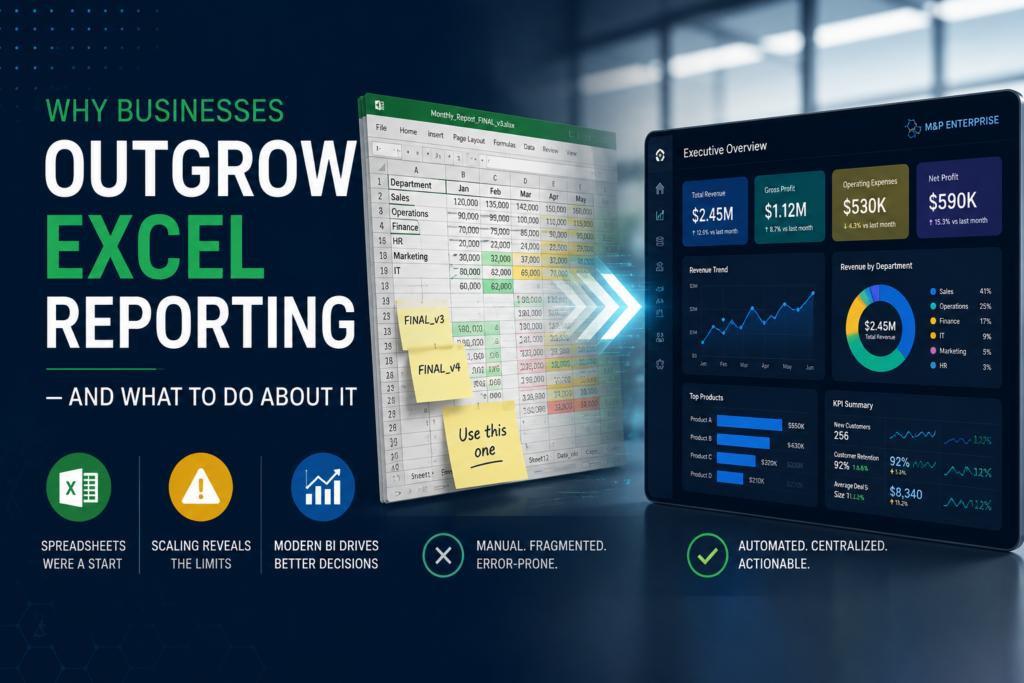
Excel is one of the most powerful tools ever built for business. It’s flexible, familiar, and works well for many organizations in their early stages. But as businesses grow, spreadsheets often become difficult to manage, leading to version-control issues, manual reporting processes, and limited visibility across the organization.
There comes a point when Excel stops being the solution and starts becoming the bottleneck. In this article, we explore the warning signs, the risks of relying on spreadsheets at scale, and how modern business intelligence platforms help organizations make faster, more confident decisions.
The Warning Signs Start Small
Most organizations don’t wake up one morning and decide they have an Excel problem.
Instead, the warning signs appear gradually.
Reports begin taking longer to prepare. Multiple versions of the same spreadsheet start circulating throughout the company. Team members spend hours manually combining information from different sources. Critical reports depend on a single employee who understands how everything works.
Eventually, questions start appearing:
- Which spreadsheet contains the correct numbers?
- Why do two reports show different results?
- Who updated this file?
- Why did this report take three days to produce?
At this stage, the issue is no longer efficiency. It becomes a matter of trust and visibility.
Decision-makers need confidence in their data. When information becomes fragmented across spreadsheets, confidence begins to erode.
Why Traditional Reporting Breaks at Scale
The challenge isn’t Excel itself. The challenge is expecting a tool designed for individual productivity to function as an enterprise reporting platform.
As businesses grow, data typically begins flowing from multiple sources:
- Accounting systems
- CRM platforms
- ERP solutions
- Inventory applications
- Cloud databases
- Operational systems
The more systems involved, the more difficult manual reporting becomes.
Employees often spend significant time exporting data, copying information between spreadsheets, cleaning datasets, fixing formatting issues, and updating formulas.
The reporting process becomes dependent on manual effort rather than automated workflows.
This creates several challenges:
Increased Risk of Human Error
Even small mistakes can create major business consequences.
An incorrect formula, accidental deletion, or outdated spreadsheet version can impact forecasts, budgets, operational planning, and executive reporting.
Limited Visibility
When data exists in separate spreadsheets, leaders struggle to see a complete picture of the business.
Departments often operate from different reports, leading to inconsistent decision-making.
Slow Reporting Cycles
Business leaders increasingly expect near real-time visibility into operations.
Waiting days—or weeks—for manually prepared reports limits an organization’s ability to respond quickly to opportunities and challenges.
The Shift to Business Intelligence
Organizations that successfully move beyond spreadsheet-based reporting typically adopt centralized reporting and analytics solutions.
Instead of maintaining multiple disconnected files, information is brought together into a single source of truth.
Modern business intelligence platforms provide:
- Automated data refreshes
- Interactive dashboards
- Real-time visibility
- Consistent metrics across departments
- Improved data governance
- Enhanced security and access controls
Rather than spending hours preparing reports, teams can spend their time analyzing information and identifying opportunities.
This shift changes reporting from a reactive process into a strategic advantage.
Better Decisions Require Better Visibility
When executives have access to trusted, timely information, decision-making improves across the organization.
Sales teams can monitor performance trends in real time.
Operations leaders can identify bottlenecks before they become larger issues.
Finance teams can reduce reporting cycles and improve forecasting accuracy.
Most importantly, leadership gains a clearer understanding of how the business is performing and where opportunities exist for growth.
Data becomes more than a collection of numbers—it becomes a business asset.
Final Thoughts
Excel remains an incredibly valuable tool and will continue to play an important role in many organizations.
However, as businesses grow, reporting requirements become more complex. What works for a small team often becomes difficult to manage at scale.
Recognizing when spreadsheets have reached their limits is an important step toward building a more efficient, data-driven organization.
Businesses that invest in modern reporting and analytics solutions gain faster access to insights, reduce operational risk, and position themselves for long-term growth.
If your organization is spending more time creating reports than acting on them, it may be time to evaluate the next stage of your analytics journey.